


Events

Around 50 institutions, forest owners, businesses and sector operators discussed development opportunities for the forest-to-primary-processing supply chain in the Italian pilot area.
The aim was to bring together those who manage the forests of the Tuscan-Emilian Apennines with those who process and buy timber. On 22 September, around 50 people gathered at Palazzo Giordani in Parma for "Local and certified – Development opportunities for the forest-to-primary-processing supply chain in the Tuscan-Emilian Apennines". The meeting was organised by project partners Tuscan-Emilian Apennine National Park, Conlegno and Etifor | Valuing Nature, with the support of the Emilia-Romagna Region.
The event created space for direct dialogue between supply and demand for locally sourced certified timber, meaning wood from forests managed according to recognised sustainability standards. Discussions focused on the resources already available in the area and how to turn them into value. Participants discussed how to increase the volume of local timber reaching sawmills and primary processing, what obstacles businesses currently face, and how certification can also become a commercial advantage.
The meeting identified the topics to work on in the coming months: timber availability and demand, the role of certification, the relationship between forest owners and businesses, primary processing, and the possibility of establishing stable agreements between timber producers and buyers. These topics require dialogue between actors who currently work on different segments of the same supply chain. For this reason, Parma marks the start of a collaboration process between the Park, the project partners and other key players in the sector.
"As coordinator of the forest certification group, the Park sees this process as a new opportunity to extend the project's benefits to the local area," says Giuseppe Vignali, Director of the Tuscan-Emilian Apennine National Park. "Certification guarantees that timber comes from responsibly managed forests and, together with a stronger local supply chain, can respond to a market that is increasingly attentive to the origin of materials. There is also an issue of great relevance for the climate: the carbon absorbed by trees remains stored in beams, furniture and other wood products, extending the benefit of our forests over time."
"Parma hosted a first meeting between supply and demand for certified timber at the local level," explains Sebastiano Cerullo, General Manager of Conlegno. "The participating businesses showed strong interest in the topic, and above all in the possibility of a guaranteed and continuous local supply. Today, around 80% of the timber used by Italian companies comes from abroad. Besides generating additional economic and environmental costs, this is a major issue that needs to be addressed through greater collaboration among stakeholders with shared interests."
Event page: https://locale-e-certificato.eventbrite.it/

Researchers from the University of Castilla-La Mancha (UCLM) presented two scientific contributions at M2GARSS 2026 in Marrakech, showcasing innovative approaches to better understand how Mediterranean forests respond to management interventions and water stress.
Although the studies were conducted in Aleppo pine (Pinus halepensis) forests, the methodologies developed are applicable to the species addressed within WOOD4LIFE, including black pine (Pinus nigra) and Scots pine (Pinus sylvestris). The research provides valuable insights that can support sustainable forest management and climate adaptation strategies across Mediterranean forest landscapes.
The first study explored how satellite-based monitoring can be used to assess forest recovery following silvicultural treatments. Using an enhanced version of the Copernicus Gross Dry Matter Productivity (GDMP) product, researchers quantified changes in forest productivity after thinning and scrub-clearing operations. The results demonstrate the potential of remote sensing technologies to monitor forest management impacts at large scales and to better understand recovery dynamics under drought conditions.
The second study focused on soil evaporation in semi-arid Mediterranean pine forests. Through an experimental setup using mini-lysimeters under contrasting sun and shade conditions, researchers evaluated how canopy cover influences water loss from the soil. The findings highlight the important role of forest structure in regulating water dynamics and improving ecosystem functioning in water-limited environments.
Together, these contributions provide new insights into two key aspects of climate-smart forestry: the recovery of forest productivity after management interventions and the role of forest structure in water conservation. Both topics are highly relevant for improving decision-making in Mediterranean forests facing increasing pressure from drought and climate change.
The presentations acknowledged WOOD4LIFE as a supporting framework for the dissemination of this research, demonstrating how scientific innovation can contribute to advancing sustainable forest management practices across Europe.

In May, Castilla-La Mancha brought WOOD4LIFE to Amsterdam for a high-level European discussion on the future of the EU Bioeconomy Strategy.
On 13 May 2026, WOOD4LIFE was presented at the side event "Initiatives for a successful green transition", held during the ERIAFF Annual Conference in Amsterdam (11–13 May 2026).
The event was jointly organised by the ERIAFF Working Groups on Forested Regions and on Bioeconomy and Resilience, bringing together policymakers and regional authorities from across Europe to explore how the new EU Bioeconomy Strategy can support the green transition. It offered a concrete space to exchange good practices and identify pathways for turning regional forest potential into economic and environmental value.
The Junta de Comunidades de Castilla-La Mancha, WOOD4LIFE's project coordinator, participated at the highest institutional level. The delegation, composed of Deputy Minister of the Environment José Almodóvar Araez, Director General for Natural Environment and Biodiversity Susana Jara Sánchez, and Head of Area Alfredo Chavarría Samper, presented WOOD4LIFE as a working example of how sustainable forest management, forest-owner governance and wood-based value chains can contribute to climate change mitigation and regional development.
The conference confirmed that the approach WOOD4LIFE is piloting in Castilla-La Mancha and the Tuscan-Emilian Apennines - connecting forests, communities and markets - is directly relevant to the broader European conversation on bioeconomy and land use.
Stay updated on WOOD4LIFE activities and results: follow us on LinkedIn and Instagram.
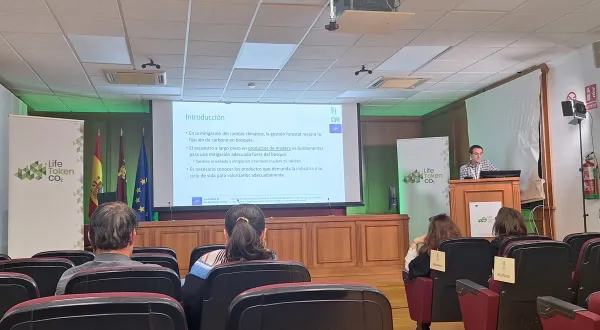
The European WOOD4LIFE project was represented at the Like Token CO2 Congress, held in Murcia from February 19 to 21, 2025, through the participation of Ricardo Ruiz Peinado, researcher at the Institute of Forestry Sciences (ICIFOR-INIA) of the Spanish National Research Council (CSIC) and partner of the project.
During his speech, Ruiz Peinado presented a paper entitled "The WOOD4LIFE project: carbon sequestration in durable wood products (from forest to industry)", in which he explained how improved forest management can contribute significantly to climate change mitigation. The presentation highlighted the role of long-lived wood products as carbon sinks outside the forest, as well as the need to revive the forest value chain to ensure sustainable and resilient management in the face of abandonment and fragmentation of forest ownership.
WOOD4LIFE, co-financed by the European Union's LIFE program, works both in Castilla-La Mancha and in the National Park of the Tuscan-Emilian Apennines (Italy), applying sustainable forest management practices that improve carbon sequestration, biodiversity and wood quality. The project also promotes innovative tools and business models to strengthen the role of the forestry sector in the transition to a low-carbon economy, in line with the European Carbon Farming initiative.